How Will Your Savings Support Your Retirement?
Explore your retirement-income priorities, understand potential risks, and learn about your options—including fixed-indexed annuities. Start with a few questions, or ask what's on your mind.
Consultations are currently available to California residents.

Carlos Milsap
Licensed Life Insurance Agent
CA DOI 0H35310
Why Trust Us With Your Retirement?
Licensed Life Insurance Agent
California DOI 0H35310
Experienced & Education-First
Clear answers, no pressure
Consultations for California Residents
General education available to everyone
Tax-Deferred Transfer
A direct trustee-to-trustee rollover between qualified retirement accounts is generally not a taxable event. Your own situation may differ—confirm with a tax professional.
No Early-Withdrawal Penalty on a Direct Transfer
A direct transfer is not treated as a distribution, so the early-withdrawal penalty generally does not apply. Eligibility and plan rules vary.
No Cost for the Consultation
The educational consultation itself is free. Annuities and other products have their own costs and features—we review those with you before any decision.
This information is general and educational and is not tax, legal, or investment advice. Tax treatment depends on your individual circumstances; please consult a qualified tax professional.
Not sure where to start? Take the Retirement Income Check-In.
Answer a few short questions at your own pace and get a plain-language recap of your priorities—or ask a question anytime. It's educational, private, and there's no pressure.
Consultations currently available to California residents.
What Our Clients Say
“Carlos took the time to explain how my old 401(k) worked and walked me through the options in plain English. I finally understood the fees I was paying.”
James R.
Retired Engineer
“The process was clearer than I expected. Carlos answered every question patiently and never pressured me. I felt educated, not sold to.”
Patricia M.
Former Healthcare Manager
“I appreciated how much time Carlos spent making sure I understood my choices before deciding anything. That peace of mind meant a lot.”
David K.
Small Business Owner
Client comments reflect individual experiences and may not represent the experience of others. They are not a guarantee of future results and are not a recommendation of any product or strategy.
The smarter home for your retirement money.
A fixed-indexed annuity (FIA) is an insurance contract designed to protect principal from market losses and offer optional lifetime income. It is different from a 401(k), which is a tax-advantaged retirement account. Whether it fits depends on your goals—here are the features people ask about.
Protection From Market Losses
A fixed-indexed annuity typically credits no less than 0% in a down year, so index declines do not reduce your principal. Guarantees are backed by the issuing insurer’s claims-paying ability.
Optional Lifetime Income
Many contracts offer an optional income rider that can provide a stream of income for life. Riders usually carry an extra charge and specific terms — and we review those before any decision.
Tax-Deferred Direct Rollover
A direct trustee-to-trustee rollover is generally not treated as a taxable distribution, so it can avoid current taxes, withholding, and the early-withdrawal penalty. Confirm your situation with a tax professional.
Index-Linked Interest
Interest can be credited based on the performance of a market index (like the S&P 500®) without being directly invested in the market. Crediting is subject to caps, participation rates, or spreads set by the insurer.
No Separate Advisory Fee
There is no ongoing asset-management fee for the consultation. Annuities can carry their own costs—such as optional rider charges and surrender charges for early withdrawals—which we explain up front.
Tax-Deferred Compounding
Like a 401(k) or IRA, you owe no tax on growth until you withdraw. More of your money compounds for you, year after year.
Fixed-indexed annuities are insurance products; guarantees are subject to the claims-paying ability of the issuing insurer. Product features, caps, participation rates, and charges vary by contract. This is general education, not tax, legal, or investment advice.
Understand the rules before you move a single dollar.
Plain-English explanations of the rules, traps, and tools that decide whether your retirement money will last — or not.
How a 401(k) Rollover Actually Works
A rollover moves money from one qualified retirement account to another while preserving its tax-deferred status. There are two ways to do it — and only one is safe.
Direct Rollover (Trustee-to-Trustee) — The Right Way
- Funds move directly from your old plan to the new account. You never touch the money.
- No 20% mandatory tax withholding. The full amount transfers.
- No 60-day deadline pressure.
- You can do as many direct rollovers per year as you need.
- This is exactly how we move 401(k) money into a Fixed Index Annuity IRA.
Indirect Rollover — The One That Trips People Up
- Plan sends a check made out to you (not the new custodian).
- IRS forces 20% federal withholding on the full distribution.
- You have 60 days to deposit 100% — you must replace the missing 20% from your own pocket to avoid taxes.
- If you miss the deadline, the entire amount becomes taxable income, plus a 10% penalty if you're under 59½.
- Almost always avoidable — just choose the direct rollover.
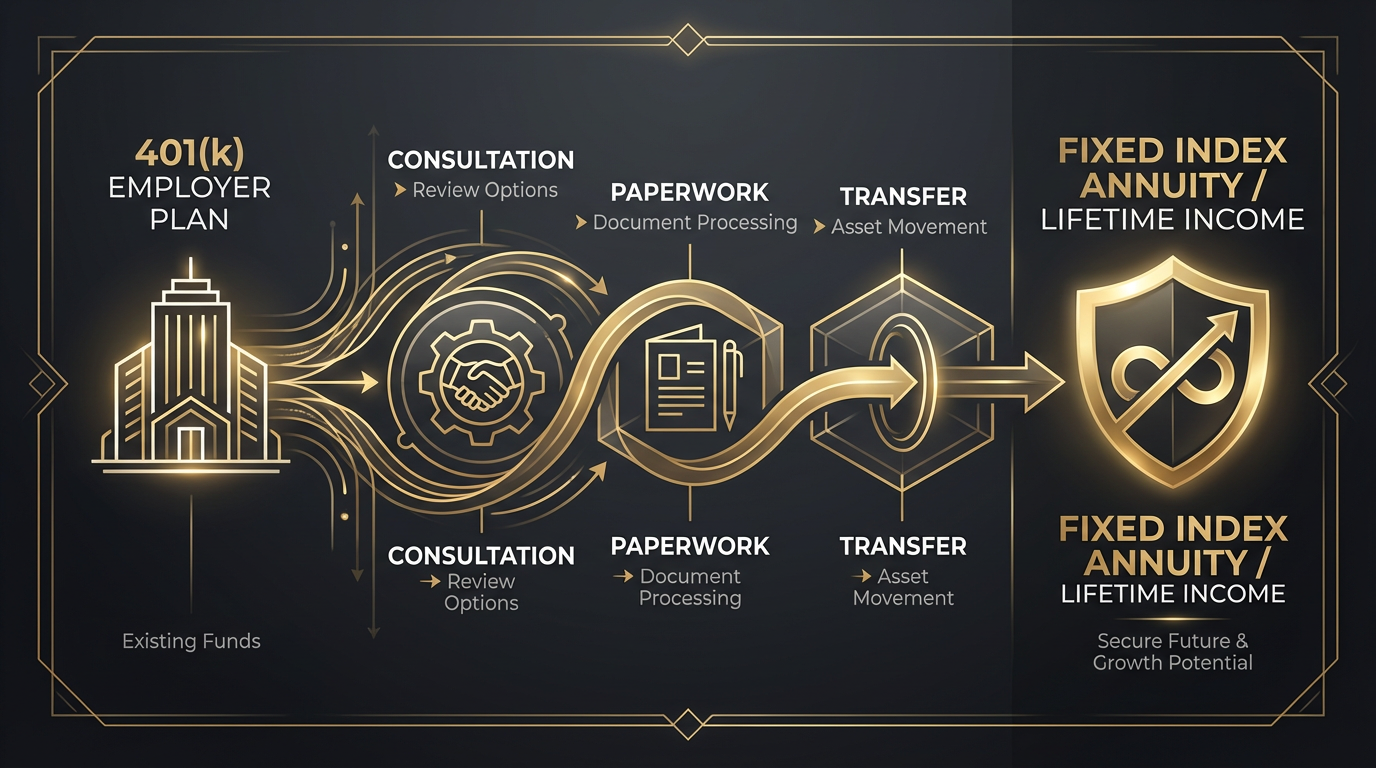
How your rollover actually happens.
A transparent, step-by-step process for those who decide a rollover fits their goals. Whether it makes sense depends on your situation—this is general education, not a recommendation.
- 11
Free Consultation
30 minutesA no-pressure call to listen to your goals, timeline and concerns. We confirm whether a rollover even makes sense for you.
- 22
Discovery — Gather Every 401(k) Detail
1–2 sessionsBefore we touch anything, we collect the full picture of your current plan: administrator, account number, balance, contribution sources, vesting, outstanding loans, beneficiaries, and the most recent fee disclosure.
- 33
Strategy & Carrier Selection
1 sessionBased on your goals, we review fixed-indexed annuity options and compare carriers, indexes, caps, participation rates, income riders, and surrender schedules side-by-side so you can see the trade-offs.
- 44
Take the Application — Open Your IRA Annuity
~1 dayYou sign the new IRA annuity application FIRST. We need the new contract/account number before contacting your 401(k) provider.
- 55
Vendor Call — Confirm Withdrawal Instructions
30–45 minutesWe 3-way call your current 401(k) provider to confirm exactly how they want the rollover processed: forms, wet signatures, Medallion Signature Guarantee, spousal consent.
- 66
Submit the Direct Trustee-to-Trustee Rollover
2–4 weeksPaperwork is submitted exactly per the carrier's protocol. Funds move directly from the 401(k) to your new IRA. A direct trustee-to-trustee rollover is generally not treated as a taxable distribution—confirm your situation with a tax professional.
- 77
Funds Shipped via FedEx — We Reimburse the Cost
1–3 business daysWe always require funds be sent via Federal Express so we can track every step. The FedEx fee (~$25) is reimbursed by us.
- 88
Policy Issued & Locked In
Day of fundingThe carrier credits the funds to your new IRA annuity, issues the contract, and your principal is now protected by the 0% floor.
- 99
Free-Look Review
10–30 daysEvery annuity contract comes with a state-mandated free-look period. If anything doesn't make sense, you can cancel for a full refund.
Important: Because this is a direct, trustee-to-trustee rollover into another qualified retirement vehicle (an IRA annuity), the IRS generally does not treat it as a distribution, so it can avoid current taxes, 20% withholding, and the 10% early-withdrawal penalty. Eligibility and tax treatment depend on your circumstances—confirm with a qualified tax professional.
Two very different jobs for your retirement money.
A 401(k) is a tax-advantaged retirement account built to accumulate. A fixed-indexed annuity is an insurance contract designed to protect principal from market losses and offer optional lifetime income. They serve different purposes—here is a general comparison.
| Feature | Fixed Index Annuity | Traditional 401(k) |
|---|---|---|
| Market Loss Protection | 0% floor — principal protected | Direct market exposure |
| Fees | No fund expense ratios; costs may include optional rider charges and surrender charges for early withdrawals | Admin fees + fund expense ratios + revenue sharing |
| Optional Lifetime Income | Available via an optional income rider (may cost extra); guarantees backed by the issuing insurer | None. You manage withdrawals yourself |
| Tax Treatment | Tax-deferred growth | Tax-deferred growth |
| Upside Potential | Index-linked, with caps / participation rates | Uncapped market returns — with full downside risk |
| Liquidity | Penalty-free annual withdrawals (typically up to 10%); surrender schedule otherwise | Highly liquid (taxes/penalties under 59½ still apply) |
| Sequence-of-Returns Risk | Reduced when guaranteed income is elected via an optional rider | Severe — a bad early year permanently shrinks income |
| Death Benefit | Account value passes to named beneficiary | Account balance passes to beneficiary |
| Best For | Protecting wealth & creating guaranteed retirement income | Long-term accumulation with risk tolerance |
Comparison shown for educational purposes. Specific contract features vary by carrier and product. Annuity guarantees are subject to the financial strength and claims-paying ability of the issuing insurance company.
Carlos Milsap — a guide for the most important money you'll ever manage.
"Most people don't need more risk in retirement. They need certainty."
Carlos Milsap is a licensed life and annuity professional based in California (DOI 0H35310) and the founder of 401(k) Rollover Experts. For years he has helped working Americans, retirees, and small-business owners better understand their 401(k) options — including how fixed-indexed annuities work and how they can help protect principal from market losses and provide optional lifetime income.
Carlos's philosophy is simple: education first, sales never. Before any paperwork is signed, you'll understand exactly how your money moves, who holds it, what it costs, and what is contractually guaranteed.
Carlos works with established insurance carriers and focuses on helping each client understand the options and trade-offs before making any decision.
The 401(k) Rollover Playbook.
Everything Carlos walks through with new clients — condensed into one downloadable PDF you can read tonight.
The 401(k) Rollover
Playbook
- Step-by-step rollover process — in plain English
- 6 common mistakes that quietly cost retirees thousands
- How a Fixed Index Annuity actually credits interest
- How optional income riders can provide lifetime income
- FIA vs. 401(k) at-a-glance comparison
- A pre-rollover checklist you can take into any consultation
Schedule your informational meeting.
Pick a slot that works for you for a no-pressure conversation about your retirement-income questions. Consultations are currently available to California residents.
The questions clients actually ask.
General, educational answers about taxes, fees, guarantees, surrenders, and how the process works. This is not tax, legal, or investment advice.
Ready to protect your retirement?
One call is all it takes to explore whether a rollover fits your goals. No paperwork, no commitments—just clear, educational answers. Consultations are currently available to California residents.